
Investment Outlook: Investing in scarcity
As economies prioritise resilience and security of supply, scarce resources may support pricing power and create potential long-term opportunities across metals, energy and technology
The value of investments can fall as well as rise and that you may not get back the amount you originally invested.
Nothing in these briefings is intended to constitute advice or a recommendation and you should not take any investment decision based on their content.
Any opinions expressed may change or have already changed.
Written by Daniel Casali
Published on 02 Nov 20266 minute read

The global economy appears to be shifting from a focus on efficiency and globalisation towards resilience and security of supply. After decades of “just-in-time” supply chains, shocks including Covid-19, geopolitical conflict and trade tensions have exposed vulnerabilities, prompting governments and companies to adopt a more defensive “just-in-case” approach.
For investors, this creates opportunities where demand is strong, but supply is difficult to expand. Three key equity areas that could potentially stand out: metals and mining, oil and gas, and compute power in information technology (IT). The core theme is scarcity. Businesses controlling scarce assets may benefit from stronger pricing power, resilient earnings and attractive long-term growth.
The world Adam Smith built
In 1776, Adam Smith published The Wealth of Nations, helping to shape a world built on specialisation and trade. Over the next 250 years, businesses became increasingly interconnected, pursuing efficiency through global supply chains, offshoring and lean inventories. The ultimate expression of this philosophy was Toyota's post-war "just-in-time" manufacturing model, which later spread across the global economy. Apple, for example, designs products in the US, sources components globally and assembles many devices in Asia. By minimising inventories and relying on global supply chains, companies reduced costs, boosted profitability and helped keep inflation low for decades.
With geopolitical tensions rising and trust declining between nation-states the once efficient, stable global trade system increasingly appears vulnerable.
As a result, governments and corporations are shifting from a "just-in-time" to a "just-in-case" mindset. Rather than assuming critical goods will always be available when needed, countries are rebuilding strategic inventories, diversifying supply chains, securing access to essential resources and reshoring production. The 2022 US CHIPS and Science Act aims to boost domestic semiconductor manufacturing. Energy and mineral security along with technological sovereignty have all become strategic priorities. In short, nations are increasingly willing to sacrifice efficiency in exchange for resilience.
What does this scarcity shift mean for investors?
Arguably, potential investment opportunities are being driven not only by earnings growth, but also by increasing strategic importance and tightening supply conditions. The opportunity lies where strong demand meets constrained supply, creating the potential for higher prices and expanding profit margins.
Some companies that could benefit from this scarcity trend may be found in metals and mining, oil and gas, and information technology sectors. So far this decade, these sectors have outperformed the global equity market. Whether in copper, energy infrastructure or data centres, the common thread is a growing willingness of governments and corporations to pay more to secure access to critical resources.
Scarcity-linked businesses may be better placed in a world of higher inflation and interest rates. Companies controlling scarce assets often have greater pricing power, helping revenues and cash flows keep pace with inflation and offset some of the valuation pressure from higher discount rates.
Critical metals, constrained supply
A significant supply gap is emerging across the metals and mining sector, particularly for critical materials such as copper. After years of underinvestment, the industry is struggling to bring on enough new supply to meet rising demand.
Berenberg projects that global mined copper production will peak in 2029. Meanwhile, copper exploration budgets have nearly halved since 2012, and new mines can take five to ten years to develop, creating a long and inflexible supply response.1
At the same time, demand is accelerating as economies electrify, power grids expand and AI-driven data centres consume increasing amounts of copper-intensive infrastructure. The market has already moved into deficit, with recycled copper increasingly required to bridge the gap. Berenberg expects this shortfall to widen to almost 32% of mined supply by 2040.2
The digital and energy transitions are increasingly constrained by physical resources. Without a sustained increase in investment, copper could become an example of how scarcity could contribute to higher prices, stronger cash flows and potentially higher equity valuations.
Energy security
Energy security has re-emerged as a strategic priority. Years of underinvestment in conventional oil and gas production, together with limited investment in refining capacity, have left global energy markets increasingly exposed to supply disruptions. In the UK, primary refining capacity is down 48% since 2009 and has fallen 11% on the continent.3 This reflects both the push for decarbonisation, which discouraged investment in fossil fuels, and a period of capital discipline following the overinvestment by US shale producers in the early 2010s. To put that in perspective, annual capital expenditure by listed global energy companies remains slightly below its previous peak in 2014, yet global crude oil and liquid fuel demand has grown by more than 10% over the same period.4
Refinery Capacity
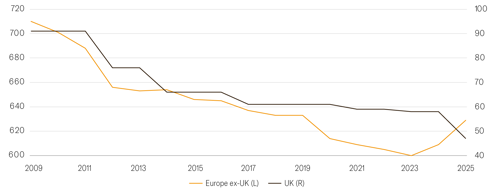
Source: Source: LSEG Datastream / Evelyn Partners, Concawe, Data as at 22 Oct 2026
Spare capacity has become more constrained, making markets more sensitive to geopolitical shocks and supply outages. Sanctions on Russia, conflict in the Middle East and attacks on critical oil and gas infrastructure have highlighted the importance of secure energy supplies and refined products such as diesel.
As a result, governments may prioritise domestic supply. China and Russia have periodically restricted refined fuel exports to preserve domestic supply, while in September 2026, the US administration considered restricting diesel exports amid high domestic fuel prices, before President Trump ruled out a ban on 2 October.
With countries placing greater emphasis on security of supply, energy markets are becoming less efficient and more fragmented. The result is a higher likelihood of sustained price volatility and a potential scarcity premium for energy assets.
The race for compute power
The development of AI represents a clear example of both structural demand and scarcity. Demand for advanced semiconductors, data centres and computing infrastructure has surged as governments and companies invest aggressively in AI capabilities, driven by both the opportunities AI presents and the strategic costs of falling behind.
Supply remains highly concentrated. Advanced chips are produced by only a handful of manufacturers, while cutting-edge fabrication facilities require tens of billions of dollars of investment and many years to construct. As a result, demand for advanced AI chips has outpaced supply, leading to growing order backlogs and extended delivery times across the semiconductor ecosystem. Reflecting these constraints, NVIDIA CEO Jensen Huang recently noted that the company's entire supply chain is "running flat out" to meet demand.5
The imbalance is evident across the wider AI infrastructure market. Dell Technologies' AI server backlog has risen from roughly $3.8bn in 2024 to $95bn today.6 Much of this demand is being driven by hyperscalers and AI developers deploying NVIDIA-powered systems. Dell's rack-scale servers have become a key route for expanding compute capacity, with orders arriving faster than manufacturers can build and deploy infrastructure.
Summing up
The current economic backdrop appears to reflect a partial reversal of the world envisioned by Adam Smith. Rather than relying solely on global markets to allocate resources efficiently, nations are increasingly prioritising resilience, redundancy and self-sufficiency. The result may be a world where security of supply is valued more highly than lowest cost.
For investors, understanding this possible shift from "just-in-time" to "just-in-case" may prove to be one of the defining themes of the decade. In a world of higher inflation and interest rates, companies with scarce assets and strong pricing power may be better placed to sustain earnings growth. The opportunities may therefore lie not where demand is strongest, but where supply is hardest to expand.
Sources:
1Bernstein, global metals and mining, The Long View – copper, 5 October 2025
2Berenberg, metals and mining, December 2025
3LSEG/Evelyn Partners, Concawe. October 2026
4LSEG/Evelyn Partners, October 2026
5Jensen Huang sees no sign of 2029 memory glut: 'You can always use more' October 2026
6Prediction: Dell's AI Server Backlog Makes It a Sneaky Way to Play the Nvidia Supercycle, the Motley Fool, 16 September 2026
Risk warning
The value of investments can fall as well as rise, and investors may get back less than they invested. Currency movements may increase or decrease returns for sterling-based investors. Past performance is not a guide to future performance. The content in this outlook is not intended to constitute advice or a recommendation, and you should not make any investment decision based on it. Our opinions may change without notice.
Download the latest Investment Outlook now.